

D.A.T.A Resort by Della operates as a military-themed luxury glamping property in Lonavala, Maharashtra, offering a distinctive take on experiential outdoor hospitality in India.
Developed by the Della Group and conceptualised by designer and hotelier Jimmy Mistry, the resort launched at a time when experience-driven and purpose-led travel was beginning to gain momentum in the domestic market.
Set within a forested landscape overlooking Shirota Lake, the property features 27 permanent luxury tents, each measuring around 500 square feet.
Rather than positioning itself as a traditional glamping resort, D.A.T.A adopts a hybrid model that combines fixed accommodation with structured, activity-led programming inspired by military training.
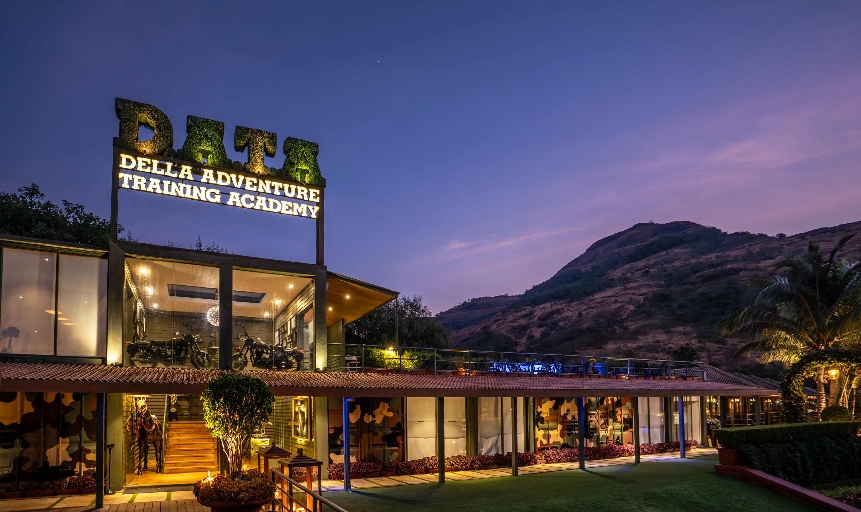
A defining element of the guest experience is its roster of former armed forces personnel, who lead physical training exercises, leadership challenges, and teamwork sessions. These activities are delivered in a controlled environment designed to accommodate a wide range of guests, including families, couples, and corporate groups.
The approach allows the resort to generate revenue beyond accommodation alone, with experiences playing a central role in the value proposition.
Despite its premium positioning, D.A.T.A Resort has maintained a deliberately low public profile. According to Bold Outline, the property operates with limited inventory and avoids high-volume tourism, instead focusing on advance bookings and smaller group formats.
This strategy has contributed to its reputation as a “hidden gem,” appealing to guests seeking exclusivity and a departure from mainstream hospitality offerings.

For glamping owners and outdoor hospitality operators, D.A.T.A Resort offers a clear example of niche positioning within a competitive market. Its thematic design, specialist staffing model, and curated programming demonstrate how experiential depth, not scale, can support differentiation and premium pricing.
The use of ex-military professionals also highlights alternative staffing and partnership opportunities for operators looking to build activity-driven guest engagement.
The resort’s model also illustrates the operational trade-offs of limited-inventory properties: lower guest volumes balanced against higher per-guest spend, more complex programming, and increased staffing coordination.
For glamping operators
D.A.T.A Resort demonstrates how strong thematic identity and structured programming can create a defensible niche, offering insights for operators considering activity-led concepts, premium positioning, or controlled-capacity developments in emerging and established glamping markets.