
Glamping Show Americas released its third Glamping Industry Report on Tuesday, offering a detailed look at emerging trends, opportunities and challenges within the rapidly evolving glamping sector.
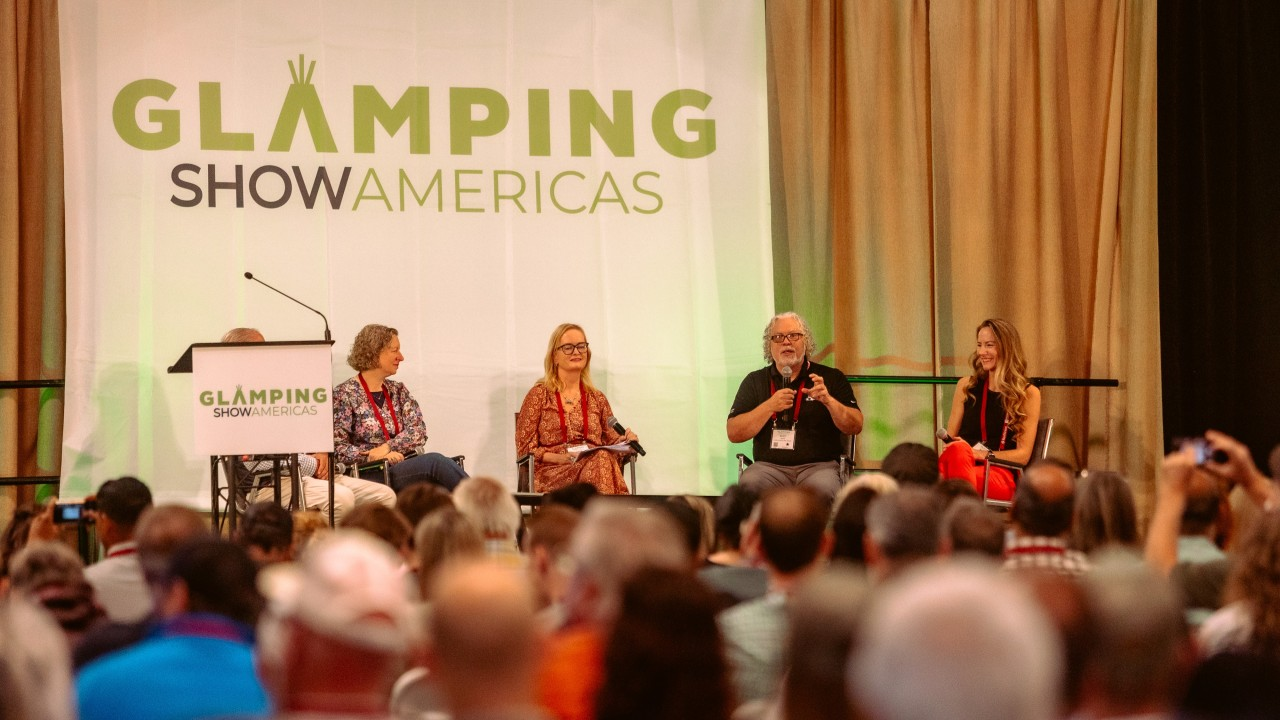
The report, compiled by Scott Bahr, president of Cairn Consulting Group, was presented during a morning session that featured Bahr alongside Sarah Dusek (Under Canvas and Few and Far), Whitney Scott (Walden Insight) and Todd Wynne-Parry (Aramark). The panel was moderated by Steph Curtis-Raleigh (International Glamping Business and Conference Co-Director of Glamping Show Americas).
Key Findings
The 2025 report highlights both growth and growing pains across the sector:
- Demand and pricing are climbing: Operators reported an Average Daily Rate (ADR) of $251/night, a 21% increase over 2023 and 11% above 2024.
- Startup costs have surged, doubling since 2023, though revenues have generally kept pace.
- Product diversification continues, with many operators now offering both on- and off-grid options; private in-suite bathrooms remain the most common feature.
- Stay requirements are split: Roughly half of operators require a two-night minimum. Pet fees remain common.
- Amenities are shifting: Recreation leads, followed by wellness-focused offerings.
- Location trends: Properties remain rooted in nature but often adjacent to urban hubs.
- Barriers persist: Financing continues to be the biggest hurdle for new entrants.
During the panel discussion, speakers emphasized the need for glamping experiences to evolve beyond accommodation alone.
“The experience has to be about more than just a unit,” said Bahr. “It also has to include an experience.”
“We’ve been talking about this for 10 years,” added Scott. “We built this market around the accommodations. On the idea that accommodations drove bookings. But really, as we’ve seen, what drives extended stays, what drives repeat guests, is the experience and amenity in service that you put around the accommodations.”
Scott also noted that price sensitivity remains a factor, particularly for families. “The majority of the camping market includes families and families are looking for stays under $250/night,” she explained.
“That’s why we see a lot of glampers in traditional campgrounds, because they have bigger amenity sets, they benefit from efficiency of the scale right there on the park, because they have 300 sites, and they have a splash park, and they have RVs, and they have accommodations.”
Another theme raised was the need for developers to engage fully with industry data rather than using it solely to validate preconceived ideas.
“It is all about the mindset of exploring a little bit and looking around for great ideas and what will work on a certain piece of property,” Scott said.