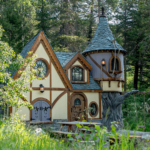

Donegal County Council has been urged to review its planning policies for glamping developments following discussions at a recent Special Plenary Meeting, where elected officials and planners examined how to balance tourism growth with development standards.
The issue was raised by Inishowen Councillor Martin McDermott, who called for a more flexible approach to planning approvals, particularly for projects located outside established town boundaries. He argued that current restrictions may be limiting tourism potential at a time when accommodation costs are rising and demand for alternative stays continues to grow.
“Different people have tried (to get planning) recently again, and we are having an issue when they are not within the town boundaries,” Cllr McDermott told Donegal Daily.
“Can we look at that policy in relation to making that more open? With the way things are going, we need to look at different ways we can bring tourism. Hotels are getting more expensive as the years go by. We are in a situation where we are not able to do that type of development in the county. Now is the opportunity.”
Council officials, however, highlighted ongoing concerns around the nature and quality of recent applications. Senior Planner Eunan Quinn noted that many proposals submitted over the past year more closely resemble permanent holiday homes rather than traditional glamping structures.
“I suppose there is a need, perhaps, to have an understanding of the range of services and developments that we are talking about, because there is a tendency to have a lot of overlap between glamping pods, which is small-scale, glamorous camping, which is different from motorhomes,” he said.
“Most of the applications that we have received, certainly since last year, most of them are essentially holiday homes as opposed to glamping pods.
“The provisions, and the preferred approach from ourselves, is that we are bolstering the facilities in our towns and villages.”
The discussion also revealed differing views on where glamping developments should be located. Councillor Ali Farren suggested that rural and remote areas are central to the appeal of glamping, particularly in locations without defined settlement zones.
“I understand that it is a body of work, but I would hate the thought that you could only get a glamping pod or touring caravan pitch next to a town or village,” he said.
“For the likes of Malin Head, where there is not a settlement area, they could be good for the area.”
In response, Quinn reiterated that the council’s priority is ensuring developments are appropriate to their setting rather than focusing on volume.
“It is not necessarily a numbers game, but what is appropriate for a certain place. High quality rather than putting in a high number of units. There are viability issues.
“Our first target is not numbers, it is quality. So you are not ending up with something that is inappropriate in a particular location.”
McDermott acknowledged the importance of maintaining standards but maintained that existing policies may be restricting viable projects.
“There are people in Clonmany and Ballyliffin who are prepared to do that high-end glamping, but they can not do it because of the policy,” he said.
For outdoor hospitality operators, the discussion highlights an ongoing challenge across many markets: how glamping is defined within planning frameworks. The council’s focus on distinguishing between low-impact, temporary accommodation and permanent structures reinforces the need for clear positioning during the application process, particularly around scale, mobility, and integration with the local environment.